Vector has been deliberating about its predictions for 2013, consulting its many informants. Here’s where we’re putting our money this year; if you have other ideas, scroll to the bottom and let us know.
Genome sequencing scaling up at health care institutions
Last year we predicted genome sequencing’s entry into the clinic; this could be the year it goes viral. Technology companies with ever-faster sequencers and academic medical centers are teaming up at a brisk pace to offer genomic tests to patients. Just in the past two weeks, a deal was announced between The Children’s Hospital of Philadelphia and BGI-Shenzhen to sequence pediatric brain tumors; Partners HealthCare and Illumina Inc. announced a network of genomic testing laboratories; Full story »
A new spinoff business will make large-scale genomic diagnostics a reality in medical practice (Image: Rosendahl)
Genomic sequencing and molecular diagnostics are becoming a global business. At the recent American Society of Human Genetics meeting, dazzling technologies for reading genetic code were on display—promising faster, cheaper, sleeker.
Nevertheless, it’s become clear that the ability to determine someone’s DNA or RNA sequence doesn’t automatically translate into useful diagnostics or even actionable information. In fact, the findings are often confusing and hard to interpret, even by physicians.
That’s where academic-industry partnerships can flourish—tapping the deep expertise of medical research centers to bring clinical meaning to sequencing findings. Yesterday, Boston Children’s Hospital and Life Technologies Corp. announced a new venture with a great list of ingredients: fast, accurate, scalable sequencing technology—Life’s Ion Proton® Sequencer—but also research and clinical experience in rare and genetic diseases, bioinformatics expertise to handle the big data, and the medical and counseling expertise to create meaning from the results. Full story »
What will happen to medically complex children if insurance coverage is reduced and fewer pediatricians are trained to care for them? (Image: Wikimedia Commons)
Jay Berry, MD, MPH, is a pediatrician and hospitalist in the Complex Care Service at Boston Children’s Hospital. His most recent research appears in the Archives of Pediatrics & Adolescent Medicine, accompanied by editorials on the findings’ implications for health care and residency training. Berry further discusses its implications in this podcast.
My first encounter with a children’s hospital was as a first grader in 1980, when my 5-year-old cousin was diagnosed with cancer. Although her family was challenged to afford her cancer treatments, St. Jude Children’s Hospital in Memphis welcomed her and treated her cancer into remission. I remember my parents saying, “Everybody in that hospital loves children. No child is turned away.”
In 1997, walking into the Children’s Hospital of Alabama as a medical student, I felt the same sense of hope and courage. Everyone on the staff believed that they could make a difference in the lives of the children and families, despite the horrific illnesses that many of the children endured. I knew, immediately, that I wanted to become a pediatrician and to learn how to care for sick children. Full story »
Mice with the mutation causing Rett syndrome (middle panel) have an excess of inhibitory connections as compared with normal mice (left panel) and mutated mice reared with no visual stimulation (right panel). Inhibitory connections were also reduced by manipulating the NMDA receptor, restoring a more normal balance of inhibition/excitation.
Research just published in Neuron offers some interesting clues about Rett syndrome, a tragic disease that causes initially healthy girls to lose their ability to speak and to develop motor and respiratory problems. Working with a mouse model, the Boston Children’s Hospital lab of Michela Fagiolini, PhD, explored how the causative mutations, affecting the MECP2 gene, disrupt brain circuitry and function. The team found that the circuit damage can be undone by targeting the NMDA receptor, tipping the brain toward the right balance of inhibition and excitation. They’re now exploring possible pharmaceutical approaches.
The study also suggests that changes in the visual system are a tip-off to what’s going on in the brain as a whole. Full story »
A “heat map” for autism gene expression (click to enlarge). Each row represents one of the 55 genes differently expressed in ASD patients vs. controls; columns show expression profiles for each of the 99 subjects. Genes in red have relatively increased gene activity; green, reduced activity. The bars along the bottom show how ASD patients vs. controls are distributed; overall, the ASD group has more genes over-expressed, while the control group has more down-regulated. The brackets at left connect genes that tend to be expressed together, while those along the top link individuals with similar gene expression patterns.
Though autism can respond well to early behavioral interventions, it’s typically not diagnosed in the U.S. until around age 5, when these interventions are less effective. Autism is diagnosed based on a child’s behaviors and language, which take time to develop to the point where clinicians can reliably assess them. What’s really needed is a fast, objective test when a child is much younger, before symptoms even show up.
In the past decade, researchers have chipped away at the problem, linking more than a dozen genetic mutations to autism—from small DNA “spelling” changes to lost or extra copies of a gene or genes (known as copy number variants) to wholesale chromosome abnormalities. Tests have been created, such as the chromosomal microarray test. But together, the known mutations account for, at best, 1 in 5 autism cases among tested patients. Full story »
It was a chance encounter. Eugenia Chan, MD, MPH, and Eric Fleegler, MD, MPH, both worked at Boston Children’s Hospital, and had met one another once or twice, but only in passing.
Running into each other at a conference, they fell to chatting. Chan, a pediatrician in Developmental Medicine, was looking for a way to measure how well patients with attention deficit hyperactivity disorder were responding to their medications. Fleegler, an emergency physician and health services researcher, described an online software program he developed to screen patients for health-related social problems and connect them with relevant services.
Two years later, Chan and Fleegler launched ICISS, the Integrated Clinical Information Sharing System, which monitors patients with ADHD and their changing medication responses. Full story »
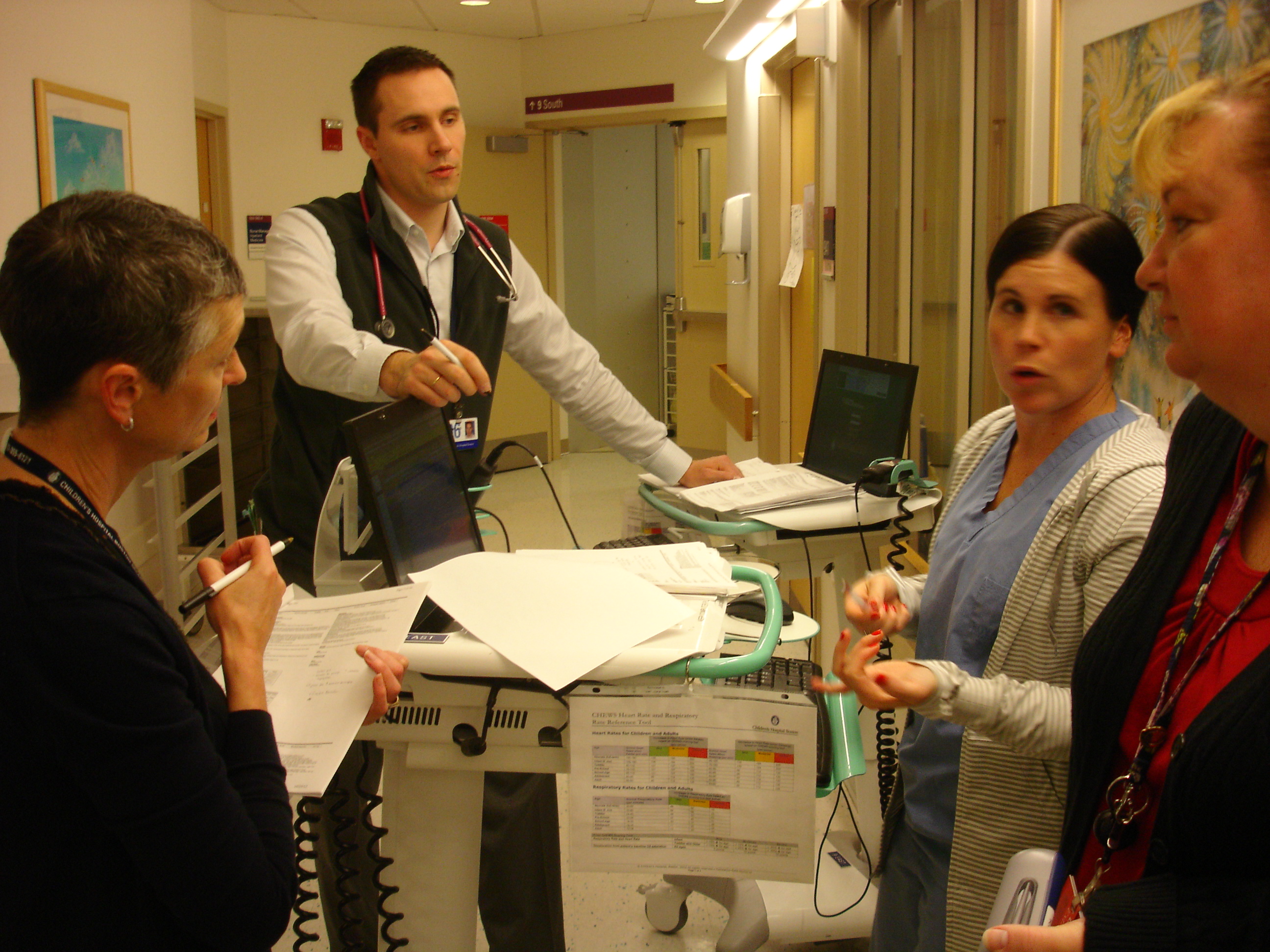
The Complex Care Service makes morning rounds. (L-R: CCS attending physician Melinda Morin, MD; pediatric resident Grant Rowe, MD, PhD; Tracy Allen, nurse practioner, CCS; Kristin Buxton, nurse practitioner, baclofen pump program.)
This is the second post of a two-part series on children with complex medical needs. (Read the first post.) Details on some patients have been changed for privacy reasons.
Led by attending physican Mindy Morin, MD, MBA, the Complex Care Service team starts down the 9th floor hall at Boston Children’s Hospital, pushing a cart carrying a computer and folders full of paperwork. They’ve just spent about an hour discussing each patient; now it’s time for morning rounds on the floor.
All the patients—some children, some adults—have illnesses affecting multiple systems in their body. Many are dependent on ventilators, feeding tubes and other technology. They are seen by physicians from multiple departments at the hospital. Morin and her colleagues provide the glue.
Some patients are asleep, their families off at work; some are attended by families who sleep in the room with them; others are rarely visited. Some smile and blow raspberries, some have limited or no social interaction. In one room, Morin lingers to talk politics with an adult patient who is still seen at Boston Children’s for his congenital condition. Full story »
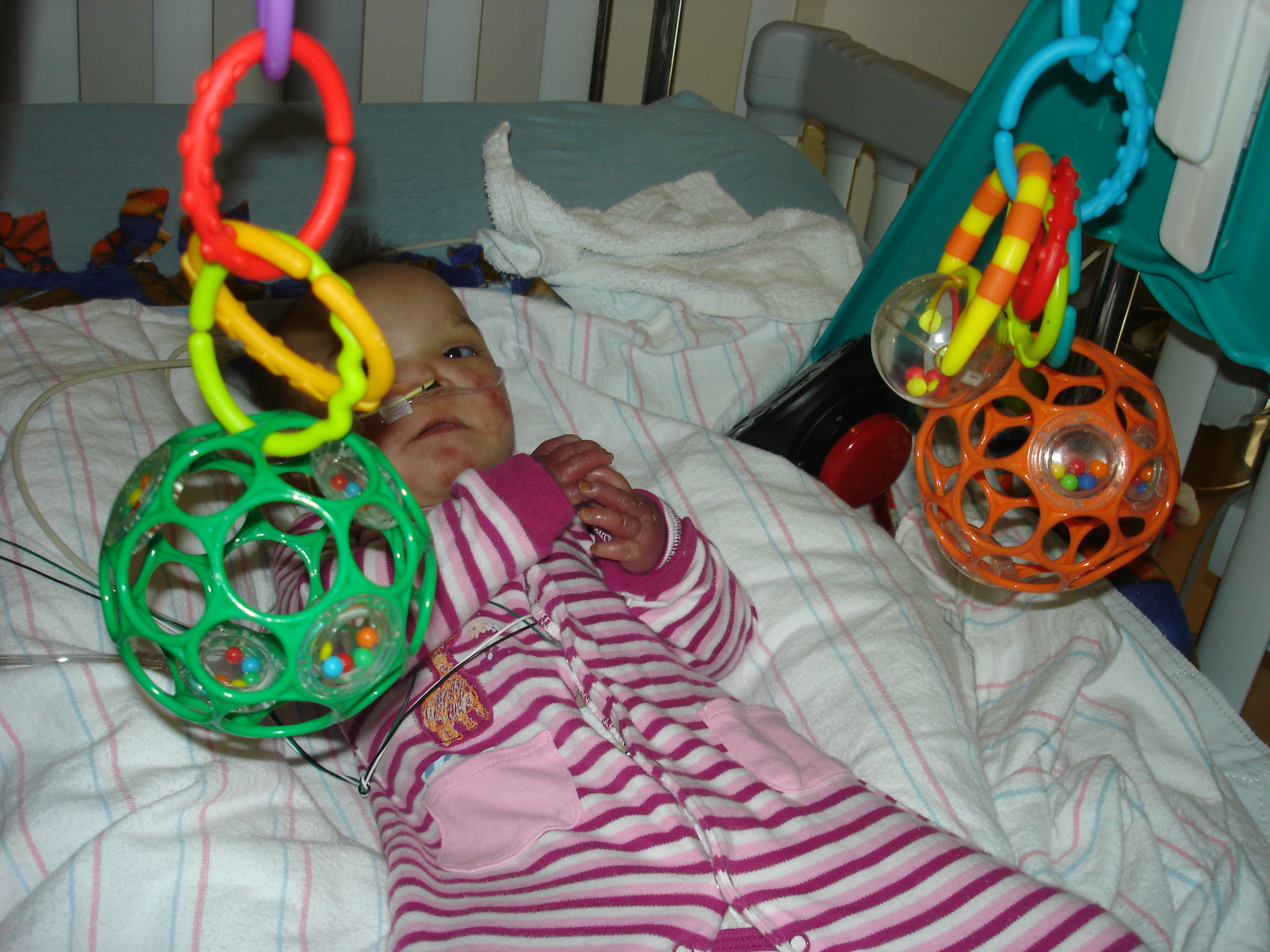
Afraa Bakhit, from the Middle East, is among the hospital's most complicated patients. Her disorder is unknown.
This is the first post of a two-part series on children with complex medical needs. Details on some patients have been changed for privacy reasons.
This morning, as every morning, the Complex Care Service (CCS) team huddles in a tiny office deep inside Boston Children’s Hospital. They have 14 patients to discuss, each with a mix of problems that involve multiple clinical departments. Many of them are repeat visitors.
The team begins tackling each case in decreasing order of difficulty. “It seems to be the best way to prioritize the patients with the most immediate needs,” says Mindy Morin, MD, MBA, who’s the attending physician this week. Also on the team are two nurse practitioners, a clinical nurse educator and two resident physicians.
Two-year-old Afraa Bakhit from Dubai tops the list for the sheer number of departments consulting on her case: Genetics, Cardiology, Immunology, Infectious Disease, Rheumatology, Pulmonology, Anesthesia and now a specialist from the Vascular Anomalies Center. Full story »
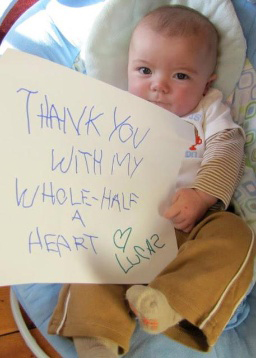
The new strategy, called staged left ventricle recruitment (SLVR), seeks to harness a child’s native capacity for growth and healing to encourage the undersized left ventricle to grow, giving the child a fully functional heart.
The two diseases are complex and serious, often occur together and are currently incurable.
The solution for PH and BPD, the two researchers from Boston Children’s Division of Newborn Medicine thought, was to protect the babies’ fragile lungs with a kind of stem cell called mesenchymal stem cells (MCSs), which can develop into lung tissue.
Their preclinical studies were pretty conclusive. If they transplanted MSCs in mouse models of BPD and PH, the mice didn’t develop the lung inflammation that triggers the disease.
But the results were a little confusing. Full story »