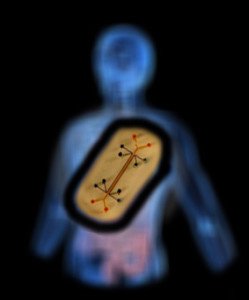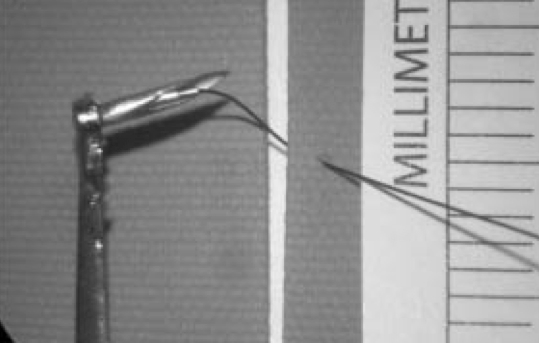
A magnetic needle and thread lets surgeons maneuver in tight spots.
The current method of suturing used in surgery—stitching with a needle and thread—has been around for thousands of years.
Kaifeng Liu, MD, a research fellow at Boston Children’s Hospital, hopes to reimagine this fundamental operating room practice. His workbench is filled with various prototypes of a magnetic needle, a device he hopes will make suturing simpler, faster and more efficient for researchers and clinicians alike.
“Sometimes it is the simplest things in medicine that stay the same over time,” says Liu, whose invention will be featured later this week at Boston Children’s Hospital’s Global Pediatric Innovation Summit + Awards 2014 (October 30-31). Full story »
Parents, clinicians, app developers, designers and more had 18 hours to prototype digital healthcare solutions at Hacking Pediatrics, produced by Boston Children’s Hospital and MIT Hacking Medicine. To accompany our earlier post, we created this Storify. Full story »
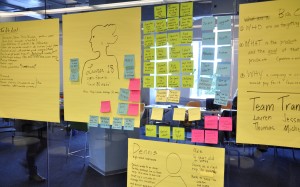
(Dana Hatic for MedTech Boston)
What are the pain points in pediatrics? There are at least 37: the number of clinicians, parents and others who lined up at the podium last weekend to pitch
problems they hoped to solve at the second annual
Hacking Pediatrics.
The hackathon, produced by Boston Children’s Hospital in collaboration with MIT Hacking Medicine, brought out many common themes: Helping kids with chronic illnesses track their symptoms, take their meds and avoid lots of clinic visits. Helping parents coordinate their children’s care and locate resources. Helping pediatric clinicians make better decisions with the right information at the right time.
Hackathons have a simple formula: Pitch. Mix. Hack. Get Feedback. Iterate. Repeat—as many times as possible. Full story »
 Where is the next generation of therapeutic innovations going to come from? Population-level genomic studies? The fitness trackers on everyone’s wrist? Mining electronic medical records? People’s tweets, Yelps and Facebook posts?
How about all of the above?
What all of these things have in common is data. Lots of it. Some of it represents kinds of data that didn’t exist 5 or 10 years ago, but all of it is slowly beginning to fuel the pharma sector’s efforts to create the next blockbuster drug or targeted therapeutic.
At least, it should be. Full story »
Health care institutions, universities and even the U.S. government are helping innovators hone their pitches and get backing.
On ABC’s reality show “
Shark Tank,” a panel of veteran investors listens to business pitches for everything from new dietary supplements to a nail salon for men. After asking tough questions, each shark either backs the venture—sometimes not for the reasons you’d think—or more likely declares, “I’m out.”
It’s a great infotainment formula—even my 10-year-old daughter is a fan—but it’s also a hit beyond the living room. Health care organizations are increasingly borrowing the “Shark Tank” script to get new ideas or to bankroll their own innovations. Boston Children’s Hospital is doing so at our Global Pediatric Innovation Summit + Awards (Oct. 30-31), bringing in “Shark Tank”’s Daymond John to moderate. But we’re certainly not alone. In recent months: Full story »

Through genetic engineering, this Vibrio cholerae biofilm can be loaded with extra antigens, creating a super-charged but inexpensive vaccine.
Malaria. Cholera. Now Ebola. Whatever the contagion, the need for new, or better, vaccines is a constant. For some of the most devastating public health epidemics, which often break out in resource-poor countries, vaccines have to be not only medically effective but also inexpensive. That means easy to produce, store and deliver.
Paula Watnick, MD, PhD, an infectious disease specialist at Boston Children’s Hospital, has a plan that stems from her work on cholera: using a substance produced by the bacteria themselves to make inexpensive and better vaccines against them.
Cells do all the work
Bacteria produce biofilms—a sticky, tough material composed of proteins, DNA and sugars—to help them attach to surfaces and survive. Full story »
 Ivan Salgo, MD, MBA, is Senior Director, Cardiology, Philips Ultrasound.
I’m thrilled to be part of the judging panel for the Innovation Tank at Boston Children’s Hospital’s upcoming Global Pediatric Innovation Summit + Awards. I can’t imagine a better way to bring together a duly combustible mixture of new thoughts and ideas with the spark of innovation.
It’s very clear that the pace of innovation needs to accelerate.
The Innovation Tank provides a rich and engaging way to accelerate innovation by putting the best ideas and technologies in front of people who can incubate and fund them, and ultimately, take them to success.
The genius of the Innovation Tank is that it coalesces a critical mass of people and ideas in a single place. By bringing ideas to the front through competition, participants can raise the bar on their own creativity to bring forth compelling ideas that matter to medicine, that matter to peoples’ lives. Full story »

Start your engines: A fleet of GoBabyGo cars, customized by therapists and parents to give disabled children mobility and help strengthen weak muscles. (Courtesy Cole Galloway)
TEDMED2014 focused on a powerful theme: unlocking imagination in service of health and medicine. Speaker after speaker shared tales of imagination, inspiration and innovation. Here are a few of our favorites:
$100 plastic car stands in for $25,000 power wheelchair
In the first (and likely only) National Institutes of Health-funded shopping spree at Toys R’ Us, Cole Galloway, director of the Pediatric Mobility Lab at the University of Delaware, and crew stocked up on pint-sized riding toys.
Galloway’s quest was to facilitate independence and mobility among disabled children from the age of six months and older and offer a low-tech solution during the five-year wait in the United States for a $25,000 power pediatric wheelchair.
The hackers jerry-rigged the toys with pool noodles, PVC pipe and switches, reconfiguring them as mobile rehabilitation devices to promote functional skills among kids with special needs. Full story »
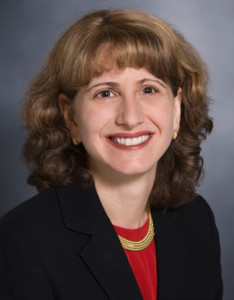 Naomi Fried, PhD, Chief Innovation Officer at Boston Children’s Hospital, will lead a panel on Innovation Acceleration at Taking on Tomorrow: Global Pediatric Innovation Summit + Awards (October 30-31, Seaport World Trade Center, Boston). Register now!
The word innovation gets thrown around a lot these days by people trying to set their products and ideas apart in the marketplace. But when everything is innovative, is anything really innovative? And if there really are innovative ideas, are they simply flashes of brilliance that can’t be planned for or predicted?
The answer to this last question is “no,” as I see every day at Boston Children’s Hospital, where I lead the Innovation Acceleration Program. The real trick is creating an innovation culture that supports great ideas—but that also supports the not-so-great ideas that teach us almost as much.
So what are the attributes of an innovation culture? Full story »