It was a chance encounter. Eugenia Chan, MD, MPH, and Eric Fleegler, MD, MPH, both worked at Boston Children’s Hospital, and had met one another once or twice, but only in passing.
Running into each other at a conference, they fell to chatting. Chan, a pediatrician in Developmental Medicine, was looking for a way to measure how well patients with attention deficit hyperactivity disorder were responding to their medications. Fleegler, an emergency physician and health services researcher, described an online software program he developed to screen patients for health-related social problems and connect them with relevant services.
Two years later, Chan and Fleegler launched ICISS, the Integrated Clinical Information Sharing System, which monitors patients with ADHD and their changing medication responses. Full story »
It’s been more than a decade since the Human Genome Project cracked our genetic code. DNA sequencing is getting cheaper and cheaper. So why isn’t it being used every day in medicine?
The truth is that while we have the technology to blow apart a patient’s DNA and piece it back together, letter by letter, and compare it with normal “reference” DNA, doctors don’t really know what to do with this information. How much of it is really relevant or useful? Should they be giving it back to patients and their families, and how?
Handled badly, the information could do more harm than good. “We don’t want to scare patients for no reason, or for the wrong reason,” says Isaac Kohane, MD, PhD, who chairs the Children’s Hospital Informatics Program.
Seeking a set of best practices for safe, clinically useful genomic sequencing, Boston Children’s Hospital took a crowd-sourcing approach. Full story »
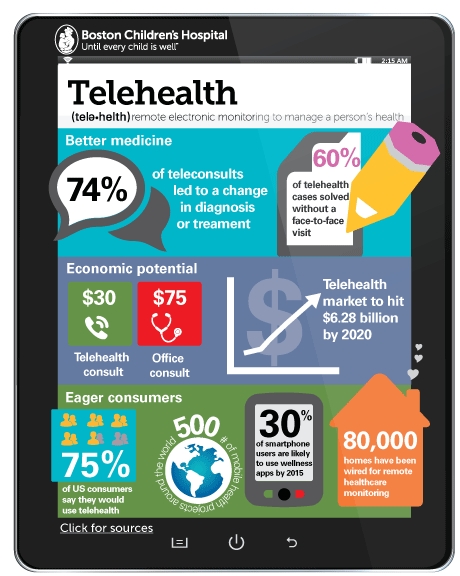
Telemedicine has the potential to transform healthcare and lower costs. A new Massachusetts law requires insurers to pay for it—but with a potential loophole.
The mandate for broader access to health care in Massachusetts has brought millions of newly insured patients into the system. At the same time, the cost of health care in Massachusetts has continued to rise, and care access issues have emerged.
This past August, Massachusetts Governor Deval Patrick signed a new law that attempts to lower costs by shifting providers away from fee-for-service payment to alternative payment models (APMs) in which they incur more financial risk, and encouraging the development of accountable care organizations (ACOs).
One provision of this law requires insurers to pay providers for services delivered remotely via “telemedicine.” Full story »
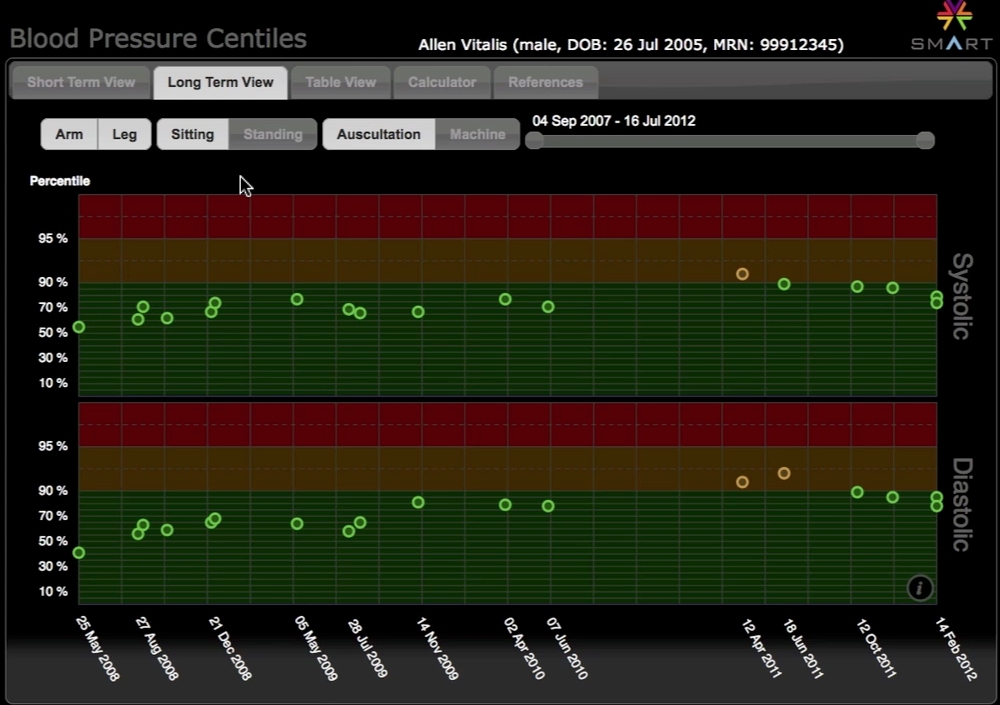
Hypertension is harder to diagnose in children than you think. A new app, which can work with multiple EMR systems, helps doctors interpret a child's blood pressure readings based on age, height, sex and measurement technique, and get the long-range view. (Click to enlarge)
The Affordable Care Act, now the law of the land, mandates free blood pressure screening for children as part of their health care coverage. Yet often hypertension in children is missed, while other children get evaluated and sometimes treated for high blood pressure readings that turn out to have been transient (often induced by kids’ fear of doctors). That has cardiologists like Justin Zachariah, MD, MPH, concerned.
“We’re both overdiagnosing and underdiagnosing hypertension,” says Zachariah, of the Boston Children’s Hospital Preventive Cardiology Clinic. “There must be a problem in the way we’re measuring it.”
Hypertension, or high blood pressure, is being seen more and more often in kids. Its prevalence 15 years ago was about 1 percent; now it’s nearly 5 percent, according to 2011 data from the American Heart Association, likely due to unhealthy diets and lack of exercise. Full story »
It may seem like just a smartphone application, but BEAPPER, a real-time alert and communication platform, has been making waves in the Emergency Department (ED) at Boston Children’s Hospital, which sees an average of 150 patients per day.
The app sends Twitter-like alerts when beds become available, when orders have been placed and when lab results are back, reducing waiting time for families. Physicians working together can view each others’ profiles, and can quickly check on their patients’ status without having to sit down at a computer and log in. Full story »
In just a few short days, London will play host to more than 10 million sports fans from around the world. Is the city ready to keep them all healthy? (Ben Sutehrland/Flickr)
In the blockbuster Contagion, Gwyneth Paltrow travels to Hong Kong on business and returns to suburban Minneapolis with flu-like symptoms. Within days she is dead. Paltrow is the index case in a pandemic that sweeps across the world. Contagion is a dramatic example of how a series of mundane, every day activities—such as shaking hands, drinking from a glass and blowing on dice for good luck—can rapidly and effectively spread disease.
Starting Friday, this year’s summer Olympics will kick off in London, the international hub of Europe. Can you imagine the potential for disease spread in a city that will host ten million athletes and tourists from all over the world? Full story »
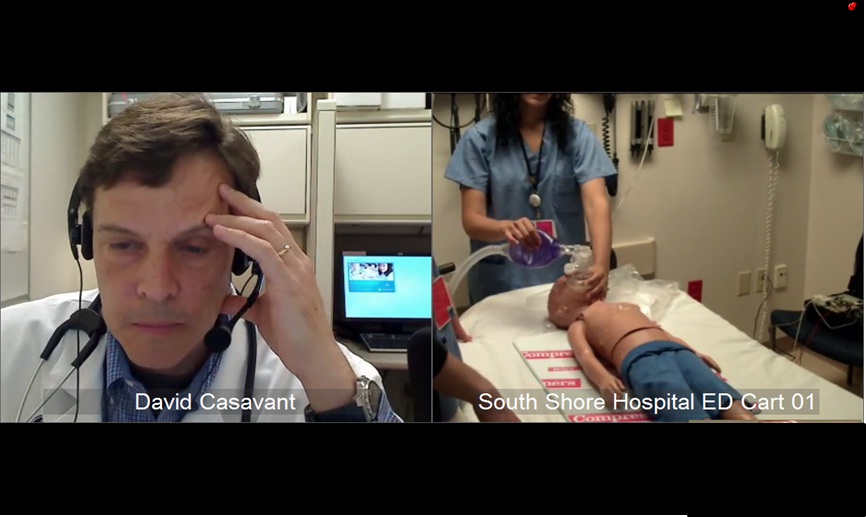
Boston Children's David Casavant, MD, in a mock TeleConnect drill with South Shore Hospital.
Naomi Fried, PhD, is Boston Children’s Hospital’s chief innovation officer. Shawn Farrell, MBA, Telehealth Program Manager at Boston Children’s Hospital, contributed to this post.
Imagine yourself in an emergency department taking care of a very sick child. Should he be transferred to a higher-level care setting? Can he safely go by ambulance, rather than helicopter? As a doctor, you would like to consult virtually with colleagues and experts at remote locations.
Then imagine yourself in a large room in the heart of Silicon Valley, just a stone’s throw from Cupertino and Apple headquarters. In that room are 5,000 of the biggest thinkers in health care and technology, exploring the next major paradigm shift in care delivery: telehealth. You realize that health care is on the brink of a telehealth explosion.
Millennials (by one definition, people born between 1981 and 2000) tend to perceive greatness as something that is inherent, not acquired. This fallacy comes in part from the coddling we were given as young people. Millennials received trophies just for participating. Thanks to grade inflation in college, we could sleep through classes and still earn a B. We were told we were special: Success came to us simply by showing up.
This type of attitude leads to inevitable discouragement post-college, when Millennials are faced with challenges they haven’t been prepared to handle. Jobs aren’t handed out just because the applicant has a degree, but instead require connections or specialized skills or experience, and once in those jobs, success doesn’t come automatically. When he doesn’t face immediate success, the Millennial assumes that he’s “different” than the successful people, and attributes the failure to an intrinsic, unchangeable quality rather than faulty methods. Full story »
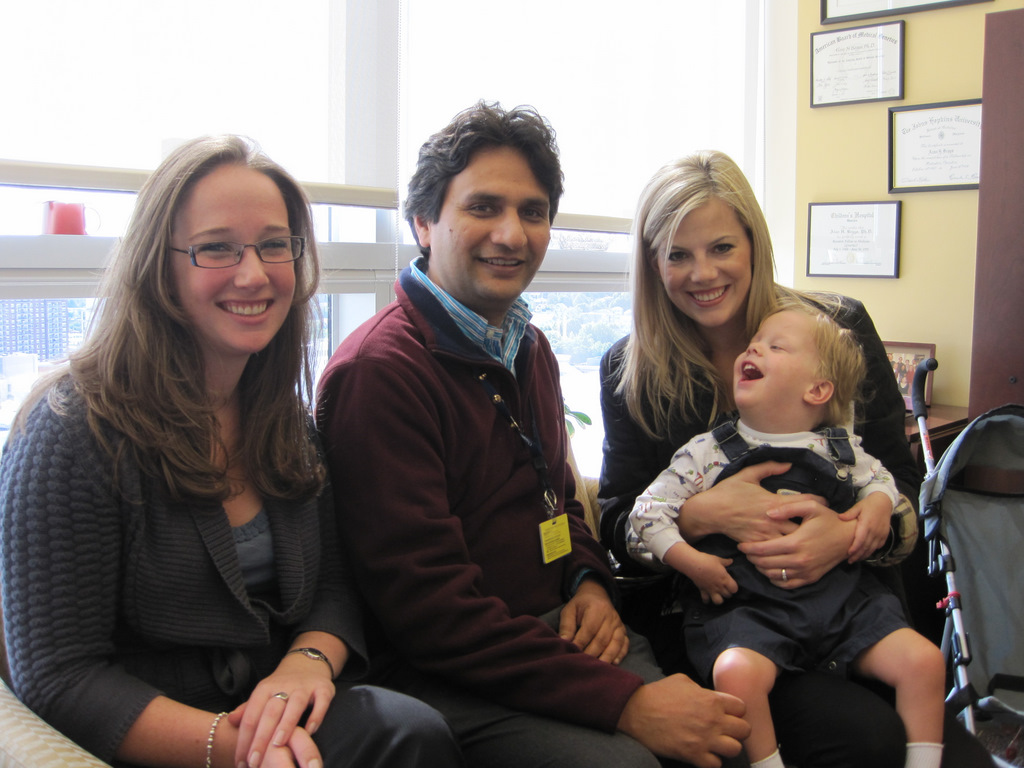
Mary Elizabeth Stone and her son John, with genetic counselor Meghan Connolly and Pankaj Agrawal, principal investigator of the Gene Discovery Core. (Courtesy ME Stone)
Sequencing a patient’s genome to figure out the exact source of his or her disease isn’t standard operating procedure — yet. But falling sequencing costs and a growing number of successes are starting to bring this approach into the mainstream, helping patients and families while advancing a broader understanding of their diseases.
The Stone family is a case in point. When John and Warren Stone were born, their parents were envisioning life raising identical twins, when suddenly everything changed. On their second day of life, the twins started to have seizures with stiffening of their arms and legs; more alarmingly, they would stop breathing from time to time, requiring a ventilator to help them breathe. Further work-up revealed that both John and Warren were having persistent seizures consistent with Ohtahara syndrome, a rare, debilitating seizure disorder.
Warren died a few weeks later, and the family transferred John’s care to Boston Children’s Hospital. An extensive clinical and genetic work-up here and at several other hospitals involved in his care — including sequencing all the genes known to cause Ohtahara syndrome – identified no cause for John’s unique seizures. Full story »
The Gutenberg press disseminated ideas to a wider society. But in the clinical world, much information is still on "lockdown." (Wikimedia Commons)
The best things in life are free: friends, sunny days, beautiful vistas. Wouldn’t it be nice if knowledge were also free? Historically, libraries promulgated knowledge sharing because it was for the public good. We see this spirit increasingly embraced on the Internet – take the recent announcement of a collaboration between Harvard and MIT to make their courses freely available to users around the world via the edX platform.
But have we made all useful knowledge available in a way that allows for the greatest societal advancement? Not really. According to Ken Mandl, MD, MPH, director of the Intelligent Health Laboratory at the Children’s Hospital Informatics Program (CHIP), one important source of information still on lockdown is clinical trial data. In an article called, “Learning from Hackers: Open-Source Clinical Trials” published this month in Science Translational Medicine (not currently available in full text), Mandl and his coauthors call for making raw, de-identified clinical trial data free to the public. Full story »