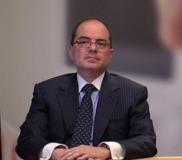
 Ivan Salgo, MD, is Chief, Cardiovascular Investigations and Philips Research Fellow for Ultrasound Research and Development at Philips Healthcare.
I’m thrilled to be part of the judging panel for the Innovation Tank at Boston Children’s Hospital’s upcoming Global Pediatric Innovation Summit + Awards. I can’t imagine a better way to bring together a duly combustible mixture of new thoughts and ideas with the spark of innovation.
It’s very clear that the pace of innovation needs to accelerate.
The Innovation Tank provides a rich and engaging way to accelerate innovation by putting the best ideas and technologies in front of people who can incubate and fund them, and ultimately, take them to success.
The genius of the Innovation Tank is that it coalesces a critical mass of people and ideas in a single place. By bringing ideas to the front through competition, participants can raise the bar on their own creativity to bring forth compelling ideas that matter to medicine, that matter to peoples’ lives. Full story »

Start your engines: A fleet of GoBabyGo cars, customized by therapists and parents to give disabled children mobility and help strengthen weak muscles. (Courtesy Cole Galloway)
TEDMED2014 focused on a powerful theme: unlocking imagination in service of health and medicine. Speaker after speaker shared tales of imagination, inspiration and innovation. Here are a few of our favorites:
$100 plastic car stands in for $25,000 power wheelchair
In the first (and likely only) National Institutes of Health-funded shopping spree at Toys R’ Us, Cole Galloway, director of the Pediatric Mobility Lab at the University of Delaware, and crew stocked up on pint-sized riding toys.
Galloway’s quest was to facilitate independence and mobility among disabled children from the age of six months and older and offer a low-tech solution during the five-year wait in the United States for a $25,000 power pediatric wheelchair.
The hackers jerry-rigged the toys with pool noodles, PVC pipe and switches, reconfiguring them as mobile rehabilitation devices to promote functional skills among kids with special needs. Full story »
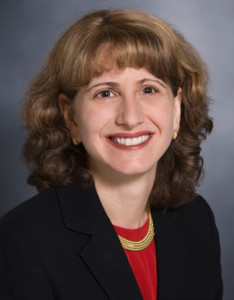 Naomi Fried, PhD, Chief Innovation Officer at Boston Children’s Hospital, will lead a panel on Innovation Acceleration at Taking on Tomorrow: Global Pediatric Innovation Summit + Awards (October 30-31, Seaport World Trade Center, Boston). Register now!
The word innovation gets thrown around a lot these days by people trying to set their products and ideas apart in the marketplace. But when everything is innovative, is anything really innovative? And if there really are innovative ideas, are they simply flashes of brilliance that can’t be planned for or predicted?
The answer to this last question is “no,” as I see every day at Boston Children’s Hospital, where I lead the Innovation Acceleration Program. The real trick is creating an innovation culture that supports great ideas—but that also supports the not-so-great ideas that teach us almost as much.
So what are the attributes of an innovation culture? Full story »

Fixing a real problem, even a small one, can transform health care.
What can innovators do to work with investors and industry to move an idea toward commercialization? Speakers at the upcoming
Global Pediatric Innovation Summit + Awards, hosted by Boston Children’s Hospital, have some simple advice: Don’t think your innovation has to be sexy.
Health care is plagued by problems that aren’t necessarily sexy or compelling, says Mandira Singh, MBA, of AthenaHealth, who will speak at the Summit’s Mobile & Digital Health panel. More than many other industries, it still depends on outdated technology. For example, it’s the only industry that continues to rely on fax machines. “These are small problems that need to be fixed,” Singh said recently at a Boston Children’s Hospital forum.
Instead of focusing on everyday challenges, innovators often think far out into the future—to where they think health care will be in 10 years. That can be a trap: Full story »
The bigger the idea, the greater the risk of failure.
Bruce Zetter, PhD, is the Charles Nowiszewski Professor of Cancer Biology at Boston Children’s Hospital and Harvard Medical School and a member of Boston Children’s Vascular Biology program. He has made significant contributions to cancer research and worked as Chief Scientific Officer at Boston Children’s Hospital. A frequent advisor to biotechnology and pharmaceutical companies, Zetter will be master of ceremonies at Boston Children’s Hospital’s Global Pediatric Innovation Summit + Awards (Oct 30-31, 2014).
By now, we have all seen a surfeit of articles on how to foster a culture of innovation in the workplace. Unfortunately, with our words, actions and tone of voice, most of us do just the opposite; we stifle innovation at every turn.
For the record, I run a cancer research lab at Boston Children’s Hospital, and innovation is our stock-in-trade, the one quality on which our performance as scientists is measured. There are no silver medals for coming in second in science. Yet even professional innovators can stifle the creative urge in their colleagues, their direct reports and even in their supervisors.
It’s easy to thwart a culture of innovation. Here are a few ways it can be done: Full story »
 Zulfiqar Bhutta, MBBS, PhD, inaugural chair in global child health at the Hospital for Sick Children, Toronto, and founding director of the Center of Excellence in Women and Child Health, Aga Khan University, Pakistan, is a global child health superstar. Presidents, prime ministers and princes welcome his advice. Yet India ignored him when he called its proposed innovation to curb infant mortality “nonsense.” “I was dead wrong,” says Bhutta. “What happened is remarkable.”
The simple innovation, which Bhutta now publicly commends, cut perinatal mortality 25 percent. Full story »
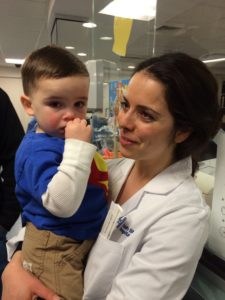
Cameron with Galina Lipton, MD
By the time Cameron Shearing arrived at the South Shore Hospital Emergency Department (ED) during a December snowstorm, he wasn’t breathing. He didn’t have much time. The two-year-old had aspirated a chocolate-covered pretzel, which sent tiny bits of material into his lungs.
The odds of a good outcome were not high. Pretzel is one of the worst foods to aspirate for two reasons: The small pieces can block multiple small airways, and the salt, which is very irritating, causes a lot of inflammation.
“Cameron was one of the sickest patients I ever cared for as an emergency physician. I did everything I could within my scope of practice, but he needed the tools and expertise of pediatric subspecialists,” recalls Galina Lipton, MD, from Boston Children’s Department of Emergency Medicine, who was staffing the South Shore Hospital emergency room that evening. Full story »
 Israel Green-Hopkins, MD, is a second-year fellow in Pediatric Emergency Medicine at Boston Children’s Hospital and a fierce advocate for innovation in health information technology, with a passion for design, mobile health, remote monitoring and more. Follow him on Twitter @israel_md.
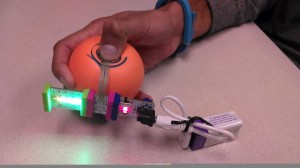
At the Hacking Pediatrics event in late October, I was fortunate to collaborate with a team interested, like I am, in patient engagement. After the initial idea-pitching phase of the hackathon, where clinicians present unsolved problems to an audience of techies and entrepreneurs, I joined a group of nearly 15 hackers who felt our desires to be similar. The prototype at left was our end result, but we had no idea then where our interest would lead.
At the beginning, in fact, our greatest challenge was determining exactly what problem we would try to solve. Full story »

Finding meals a whole family can eat—including kids with food allergies—can be like solving a Rubik’s cube.
Elizabeth Hait, MD, MPH, wears many hats. She’s a physician, researcher, wife and mother just to name a few.
But she never fancied herself an innovator—until recently. After participating in Hacking Pediatrics, sponsored by Boston Children’s Hospital in collaboration with MIT’s H@cking Medicine, she now sees potential innovations and innovators everywhere.
“To be an innovator, you don’t need to be extraordinary, you just need to recognize that a problem exists and be dedicated to fixing it,” she says.
The problem she took to last month’s Hacking Pediatrics Hackathon stems directly from her work. As co-medical director at Boston Children’s Eosinophilic Gastrointestinal Disease (EGID) Program, which treats specific food allergies causing gastrointestinal inflammation, she sees families constantly struggling to find new (and healthy) meals that won’t trigger an allergic reaction in their kids.
“Many of our patients can only safely eat a handful of foods, so feeding them with any kind of variety is extremely hard,” she says. “Then if you factor in the likes, dislikes and other food intolerances that often exist in a family, just planning one family meal can feel like a nightmare.” Full story »

(Diane Campbell Payne, used with permission)
Naomi Fried, PhD, is chief innovation officer at Boston Children’s Hospital. This post is adapted from her remarks at the Connected Health Symposium on October 24, 2013. She tweets @NaomiFried.
In the health care industry, we rely heavily on regulations to ensure the safety of our patients, procedures and drugs. New national health care regulations can even spur innovation in care delivery, but in the case of telehealth, they can be an impediment.
Telehealth, the remote delivery of care via computers, mobile devices, videoconferencing and other technologies, has great potential to improve the patient experience and reduce health care costs by removing the barriers of brick and mortar. At Boston Children’s Hospital, the Innovation Acceleration Program’s pilot telehealth programs have focused on both direct patient care and virtual clinician-to-clinician consultations.
Unfortunately, most states’ regulations are limiting providers’ ability to broadly offer telehealth services. Full story »